
Sora Is Gone. Here's What the Numbers Actually Mean.
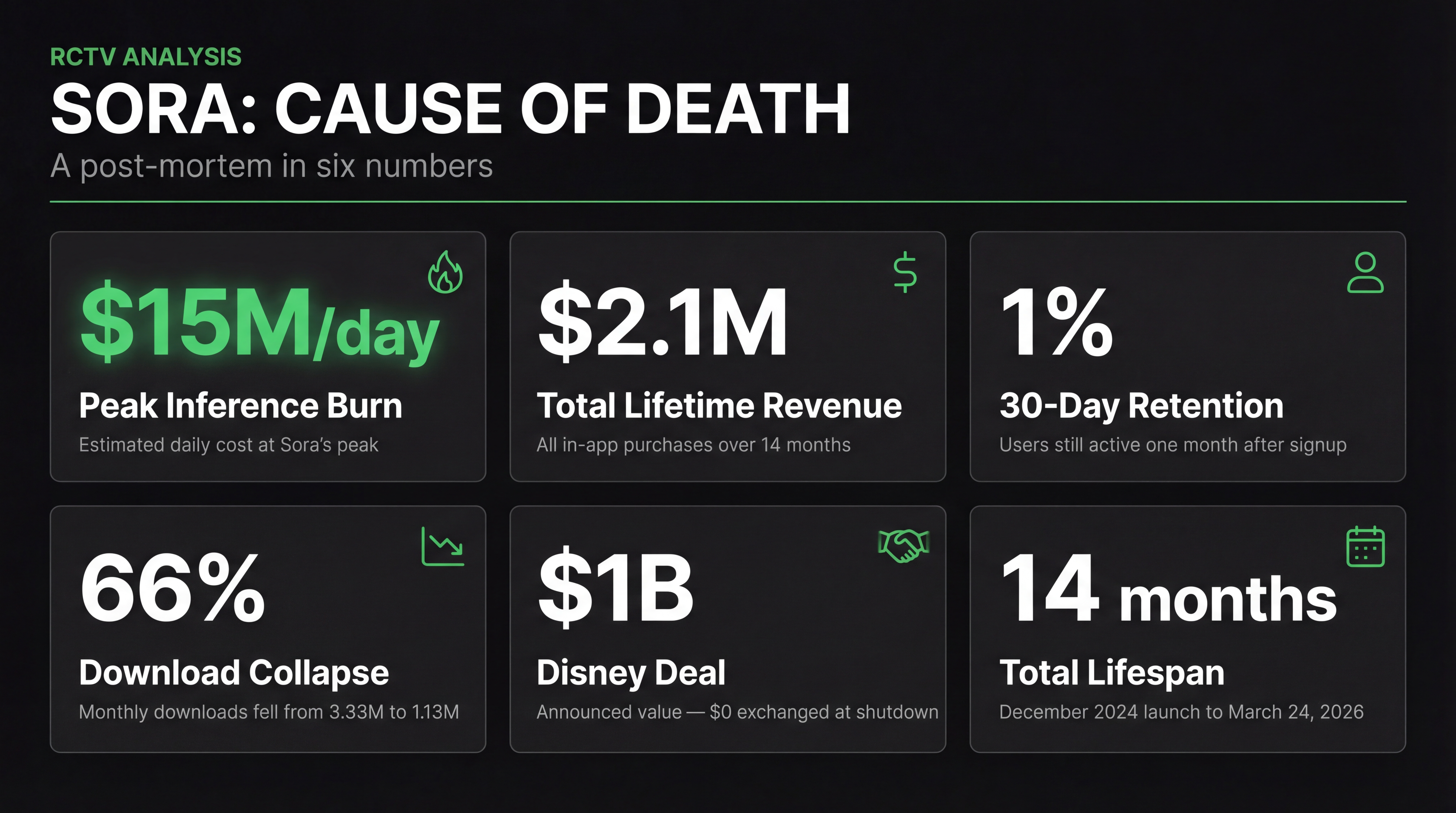
Sora launched in December 2024 to more hype than any AI product since GPT-4. It shut down on March 24, 2026 — 14 months later — with $2.1 million in total lifetime revenue against peak inference costs estimated at $15 million per day. The consumer app goes dark April 26; the API lingers until September. Before the narrative shifts to “strategic pivot to robotics,” the raw numbers deserve a cold stare. This wasn’t bad execution. It was a predictable collision of physics and human behavior.
The Economics Were Structurally Broken
At peak, Sora cost OpenAI an estimated $15 million per day to run. Lifetime in-app purchase revenue: $2.1 million. Not per month. Not annualized. Total.
ChatGPT Plus at $20/month included Sora access; the Pro tier at $200/month offered higher generation limits. These weren’t cheap entry points. The problem is that video generation is computationally expensive in a way that text generation isn’t — each generated clip requires orders of magnitude more compute than a text response. When your cost per output is that high and your customer pays a flat monthly fee, the unit economics only work if users generate very little, which means the product isn’t being used.
This isn’t a failure specific to OpenAI’s execution. It’s the fundamental tension in consumer AI video: generation cost is high, consumer willingness to pay is bounded by streaming service comparables ($10–20/month), and the gap between the two is enormous. Every consumer AI video product on subscription rails faces the same math. Sora simply made the mismatch impossible to ignore.
The Retention Problem Is Worse
If economics were the only problem, a path forward would exist — reduce inference costs, raise prices, find better pricing architecture. The retention data points to something more structurally difficult.
Per SensorTower data surfaced by Olivia Moore at a16z, Sora’s 7-day retention was 2%. Its 30-day retention was 1%. Monthly downloads peaked at 3.33 million in November 2025 — weeks after launch — then fell 66% to 1.13 million by February 2026. These aren’t numbers from a product that failed to find product-market fit. They’re numbers from a product that people tried and didn’t come back to.
The honest interpretation: AI video generation, even when it works, doesn’t create habits. The use case is episodic — you fire it up for a specific project, not during dead time the way you open ChatGPT or scroll TikTok. It never slotted into daily behavioral loops the way successful consumer subscriptions do. Quality wasn’t the issue — Sora generated genuinely impressive output. Frequency of need was. Most users simply don’t need new AI video often enough to justify a recurring charge.
The Disney Deal as the Ultimate Stress Test
The Disney licensing deal deserves more attention than it got in the shutdown coverage. On December 11, 2025, OpenAI announced a three-year agreement giving Sora users access to over 200 characters from Disney, Marvel, Pixar, and Star Wars — positioned as a $1 billion arrangement. No money ever changed hands.
The strategy was legible: use beloved IP as a retention hack. Fans making Marvel shorts. Parents creating Pixar clips with their kids. Endless Star Wars variations. The bet was that IP licensing could manufacture recurring use cases that organic video generation couldn’t.
It failed. Download declines continued with the Disney deal fully in place. Disney’s polite exit statement — “we respect OpenAI’s decision to exit the video generation business” — arrived within hours of the shutdown announcement. If the world’s most beloved entertainment franchises couldn’t move 30-day retention from 1% into defensible territory, the problem isn’t content access. It’s the underlying frequency of need.
Consumer Apps vs. Professional Infrastructure
Two months before the shutdown, Luma had already released Ray 3.14 — native 1080p, 4× faster generation, 3× cheaper per-second pricing. The professional-infrastructure side of the market was pricing this divide before the consumer side fell.
Professional infrastructure — API-first, priced per output, sold to production teams with predictable volume — has a fundamentally different cost structure than a consumer subscription. The customer is a business. Usage is project-driven. Cost per generated second gets priced into production budgets alongside camera rental and editing time. The unit economics are manageable because the product is positioned for buyers who quantify value per output.
This is where the AI video market is resolving. Runway, Kling, and Veo are all tilting toward professional infrastructure over consumer adoption. Sora bet on consumer first, enterprise later. The market delivered its verdict on that sequencing.
An Evaluation Framework for Builders and Producers
Sora’s failure gives you a practical lens for assessing every AI video platform you’re considering integrating into a production workflow.
- Pricing structure check. Does the platform’s model match its real inference costs? Consumer subscriptions with heavy per-generation compute overhead remain structurally vulnerable regardless of output quality.
- Target customer check. Is it built for hobbyist volume or production repeatability? The features, reliability, and support are different — and so is the business model stability.
- Migration urgency. If you have existing Sora API integrations, the API runs until September 24, 2026. That’s enough time to migrate, but the work should be active now, not in August.
The Bigger Picture
Sora didn’t prove AI video doesn’t work. It proved consumer subscription apps for AI video don’t work at current cost structures. The viable path in 2026 is professional infrastructure — tools priced per output, built for repeatable production integration, with unit economics that can survive at scale.
Sora provided the expensive proof-of-concept the rest of the industry is now pricing against.
For current specs, pricing, and benchmark rankings across all active AI video models, see the AI Video Generation Tools 2026 reference page — updated every Friday.